
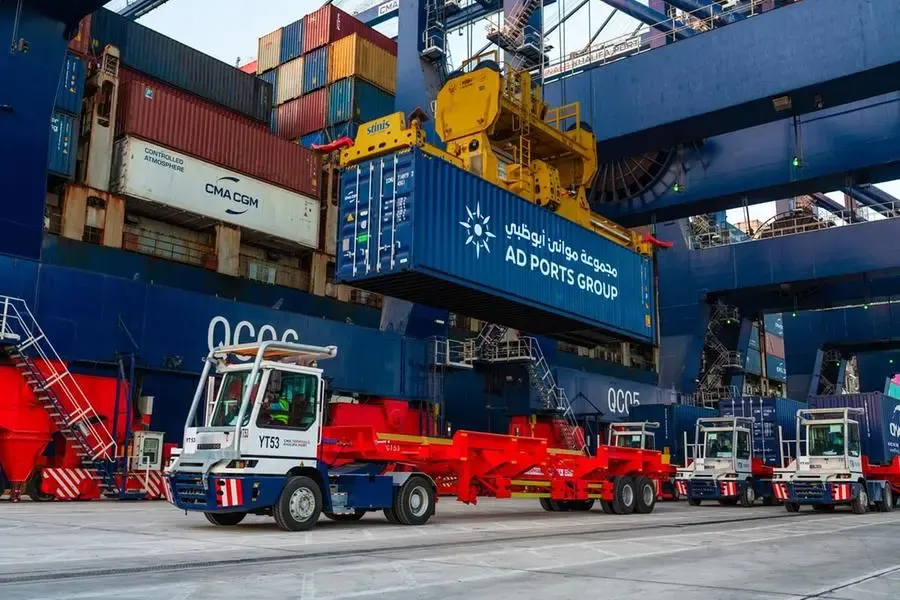
AD Ports Group has increased its global network to 36 ports and terminals with the addition of Aqaba Multipurpose Port in Jordan, marking another step in the Abu Dhabi-based operator’s overseas expansion strategy.
Ahmed Al Mutawa, Regional Chief Executive Officer of AD Ports Group, said the company’s footprint now stretches across the Middle East, Central Asia, Africa and Europe, covering the UAE, Jordan, Kazakhstan, Pakistan, Spain, Egypt, Tanzania, Angola, Cameroon and the Democratic Republic of Congo. He told the Emirates News Agency that the enlarged portfolio reflects a sustained push to position the group as a leading international trade and logistics enabler.
The inclusion of Aqaba Multipurpose Port strengthens AD Ports Group’s presence on the Red Sea corridor, a strategic artery linking Asia, Europe and Africa. Aqaba serves as Jordan’s primary maritime gateway, handling general cargo, bulk shipments and project logistics. Control of operations there provides the Abu Dhabi operator with a foothold in a market that connects to Iraq and the Levant while offering access to hinterland trade routes.
AD Ports Group, established in 2006 and listed on the Abu Dhabi Securities Exchange in 2022, has pursued an aggressive growth model built on acquisitions, long-term concessions and joint ventures. Since its public listing, the company has expanded beyond its domestic base at Khalifa Port and other UAE facilities into markets that offer both emerging trade volumes and strategic geographic positioning.
The group’s strategy has mirrored a broader trend among Gulf-based infrastructure players seeking to diversify revenue streams beyond hydrocarbons and domestic port operations. With global supply chains undergoing realignment due to geopolitical tensions, shipping disruptions in the Red Sea and shifts in manufacturing hubs, port operators have sought to secure assets along key corridors to ensure resilience and long-term throughput growth.
Aqaba’s addition complements AD Ports Group’s other regional investments, including terminals in Egypt and logistics platforms in Central Asia. In Kazakhstan, the group has developed dry port and logistics capabilities that feed into the Trans-Caspian International Transport Route, often described as the Middle Corridor, linking China to Europe via Central Asia and the Caucasus. That corridor has gained prominence as shippers look for alternatives to routes affected by geopolitical tensions.
In Africa, AD Ports Group has secured concessions and partnerships in countries including Tanzania, Angola and the Democratic Republic of Congo. These investments align with forecasts from maritime analysts that sub-Saharan Africa will see sustained container growth driven by population expansion, urbanisation and rising consumer demand. At the same time, infrastructure gaps and regulatory complexities present operational challenges that require long-term capital commitment and local partnerships.
The group’s European footprint includes operations in Spain, reflecting a strategy to integrate assets along both ends of major trade routes. By combining ports, logistics services and maritime operations, AD Ports Group aims to offer end-to-end supply chain solutions rather than standalone terminal services.
Financially, the company has reported steady revenue growth since its market debut, supported by maritime services, logistics and economic cities alongside port operations. Analysts note that diversification across geographies and business segments can cushion volatility in shipping cycles, though overseas expansion also exposes the group to currency risk, political uncertainty and execution challenges in unfamiliar markets.
The Red Sea region, where Aqaba is located, has faced security pressures affecting commercial shipping lanes. Industry observers say port operators must balance opportunity with risk, particularly when maritime routes experience disruption. By embedding itself in multiple corridors — from the Arabian Gulf to the Mediterranean and across Africa — AD Ports Group appears to be hedging against concentration risk.
mubadala-exits-arcadia-stake-following-bansk-led-takeover/” target=”_self” rel=”nofollow” class=”sb1d43ecae73455340c3604b2631aaa41″>
Jordan’s Aqaba Special Economic Zone has long sought to attract foreign investment to upgrade port infrastructure and enhance efficiency. Integration into a larger international network could bring capital, operational expertise and digital systems aimed at improving turnaround times and cargo handling capacity. For AD Ports Group, the port offers not only throughput potential but also geopolitical relevance, given Jordan’s position as a stable gateway in a volatile region.
Competition in the global port sector remains intense
Major operators from Europe and Asia continue to expand through mergers and concession bids, while regional players in the Gulf are also investing heavily. The ability to secure long-duration concessions and align with national development agendas has become critical to sustaining growth.
Notice an issue?
Arabian Post strives to deliver the most accurate and reliable information to its readers. If you believe you have identified an error or inconsistency in this article, please don’t hesitate to contact our editorial team at editor[at]thearabianpost[dot]com. We are committed to promptly addressing any concerns and ensuring the highest level of journalistic integrity.