
11
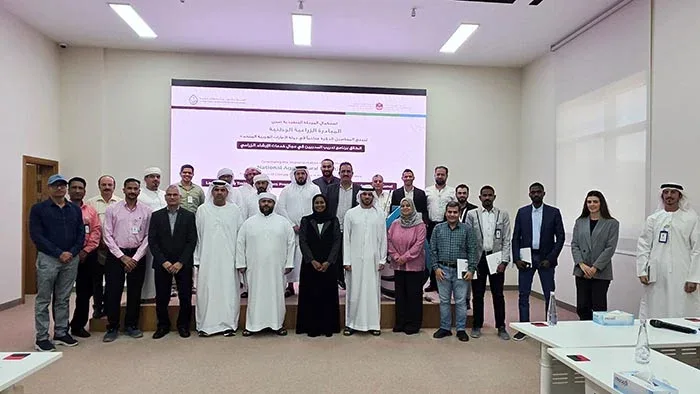
The International Center for Biosaline Agriculture (ICBA) organised the Training of Trainers Programme for Agricultural Extension Service Professionals, equipping 20 trainees to support the expansion of climate-smart crop cultivation across 45 selected farms throughout the Emirates. The programme focused on translating ICBA’s scientific expertise into practical guidance for farmers, with technical support and monitoring to help diversify agricultural production and improve resource-use efficiency.
The programme forms part of the National Agricultural Initiative for the Adoption of Climate-Smart Crops in the UAE, launched jointly by the Ministry of Climate Change and Environment and ICBA in April 2026. The initiative draws on agricultural research to diversify local food and fodder production and improve water-use efficiency, in line with the National Food Security Strategy 2051.
During its first phase in 2026, the initiative focuses on expanding cultivation on selected farms, training 45 Emirati farmers and preparing agricultural extension
service professionals to support implementation. The second phase, planned for 2027, focuses on commercial expansion and private-sector partnerships. Together, these phases support the development of agricultural value chains, from seeds and cultivation through to harvesting, processing and marketing, creating economic opportunities and strengthening farmers’ livelihoods.
Dr. Tarifa Alzaabi, Director General of ICBA, said: “Environmental challenges and growing pressure on natural resources make it increasingly important to expand the cultivation of climate-smart crops that thrive under local conditions and use resources efficiently. This programme equips agricultural extension service professionals with the scientific knowledge and practical expertise to support farmers in growing these crops and expanding their adoption across the Emirates.”
The programme’s sessions were delivered by ICBA experts and addressed the initiative’s objectives, components and implementation schedule, together with
participants’ responsibilities in supporting farmers.
Particular attention was given to collecting reliable, consistent field data to document crop performance and guide technical follow-up. Participants were introduced to a digital data-collection tool adapted to the project’s requirements, alongside procedures for data quality and scientific validation. They also discussed opportunities for cooperation, anticipated challenges and next steps. The programme concluded with the presentation of certificates of appreciation.
Ongoing field monitoring will help ICBA’s research team and extension service professionals identify farmers’ needs and respond to production challenges. By
connecting applied research with practical support, ICBA is helping farmers expand climate-smart crop cultivation and contribute to sustainable agricultural production in the UAE.