
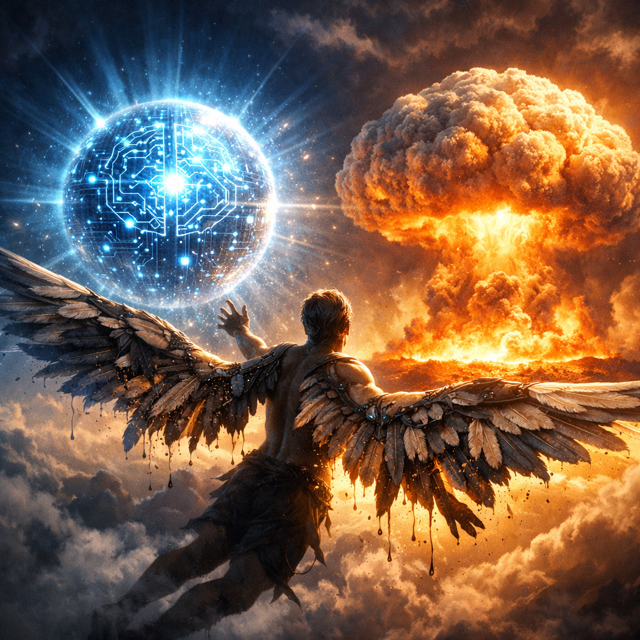
There is an image that has crossed the centuries and still speaks to us with unsettling relevance: Icarus flying toward the sun. He does not fly out of necessity, nor to survive. He flies because he can. The myth of Icarus is not merely a tale about youthful recklessness, but a radical metaphor for human nature itself — the irresistible pull toward what lies beyond the limit. Human beings are the only creatures aware of their own finitude and, at the same time, profoundly unable to accept it. We know we are mortal, yet we build as if we were eternal. We know we are limited, yet we behave as if limits were merely technical obstacles. This inner fracture — between awareness of finitude and aspiration to infinity — is the silent engine of human history. From caves to nuclear fusion, from the wheel to quantum computers, from writing to artificial intelligence, every era has had its own Icarus. Today the wings are made of silicon, algorithms, and data centers.
There is also a distinction we rarely confront honestly: the difference between discovering and understanding. Scientists are not trained to be moral philosophers; their task is to push the frontier of knowledge forward. Throughout history, transformative discoveries have almost always been made before society truly grasped their implications. The Manhattan Project remains the clearest example: an extraordinary scientific enterprise, an unprecedented concentration of intellect focused on making possible what only a few years earlier had seemed unimaginable. The result was both catastrophic and transformative. The same knowledge that produced the atomic bomb opened the path to nuclear medicine, energy generation, fusion research, and a deeper understanding of matter itself. Discovery is neither inherently good nor evil — it is power. The problem arises when power grows faster than the ethical and political maturity needed to govern it. After the Trinity test, Robert Oppenheimer quoted the Bhagavad Gita: “Now I am become Death, the destroyer of worlds.” It was not theatrical rhetoric but the recognition that humanity had crossed a threshold. Today we face a comparable one.
Every technological revolution shifts the boundary of what is possible. The Industrial Revolution replaced muscle power: machines performed tasks that once required human labor, generating economic growth and social transformation, but also inequality, exploitation, and political upheaval. Every technological leap produces two simultaneous effects: an expansion of human potential and a compression of society’s time to adapt. Artificial intelligence does not replace physical strength; it replaces — or amplifies — cognitive capability. It generates text, analyzes data, designs molecules, writes code, and increasingly makes decisions. The difference from previous revolutions is not only qualitative but temporal. The Industrial Revolution unfolded over a century; AI evolves in cycles measured in months. Society no longer has the organic time required to adjust.
We now take for granted that generative AI is only an intermediate stage
Beyond it lies AGI, and beyond that, superintelligence — an intelligence not merely comparable to the human mind, but capable of surpassing it in every cognitive domain. Yet we rarely pause to ask the fundamental questions: What is the limit? Does one exist? Who defines it? According to what principles? Under what global governance? Technological competition is no longer merely economic; it is geopolitical. During testimony before the U.S. Congress, former Google CEO Eric Schmidt emphasized that artificial intelligence has become a national strategic priority and warned that, if current growth continues, data centers could consume an enormous share of available energy — in extreme scenarios, up to 99 percent — unless new energy sources are developed in parallel. Imagining a world in which most energy production is devoted to machines that learn, compute, and simulate creates a striking paradox: in building the intelligence of the future, we may compromise the environment that makes human life possible. Yet an equally compelling possibility exists — that AI itself could help solve the energy challenge by optimizing grids, discovering new materials, accelerating fusion breakthroughs, and improving efficiency. Once again, power proves fundamentally ambivalent.
In Greek myth, Prometheus steals fire from the gods to give it to humanity; in the story of Icarus, a human being attempts to rise to the level of the sun. In both cases, the underlying impulse is the same: the desire to cross the boundary between the mortal and the divine. Modern technology has turned this metaphor into tangible reality — genetic editing, brain–machine interfaces, radical life extension, artificial intelligence. We are no longer merely using tools; we are altering the fundamental conditions of existence. Human beings are biologically predisposed to perceive themselves as the center of the world — a perception that once aided survival but, amplified by technology, can become dangerous. The temptation is not only to progress but to control, design, and ultimately replace. To play the demiurge is to assume responsibility proportional to the power one wields. The unavoidable question is whether we are prepared for that responsibility.
History shows that humanity often learns through crisis. After the atomic bomb came nonproliferation treaties; after financial collapses, new regulations; after world wars, new international institutions. But AI moves at a speed that makes this pattern difficult to apply. There is no longer a clear “after” in which to reflect — only a present that accelerates continuously. Technological governance is fragmented, competition among states is intense, and economic incentives are enormous. The most unsettling question is not whether AI will become more powerful, but whether our political and moral frameworks will evolve at the same pace.
A common narrative portrays artificial intelligence as an autonomous threat. Yet history suggests the true danger has never been the tool itself, but the human being wielding disproportionate power without systemic vision, justifying every decision in the name of competition. Icarus does not fall because the wings are flawed; he falls because he ignores the limit — or perhaps because he refuses to accept that it exists. The same drive that has produced art, science, philosophy, and space exploration has also produced world wars, environmental destruction, and systemic crises. We cannot eliminate this tension, but we can make it conscious.
Consider two possible futures
In the first, the race toward superintelligence is driven solely by geopolitical and economic competition: energy is mobilized at any cost, inequality deepens, and strategic decisions concentrate in the hands of a few. In the second, the same technology is embedded within a framework of shared responsibility, helping address energy, climate, and health challenges while governance evolves alongside computational power. The difference between these futures is not technical but cultural. It depends on our ability to recognize limits not as defeat, but as a structural condition of being human.
History suggests humanity does not stop. It never has, and likely never will. The real question is not whether we are building ever larger wings, but whether we are also learning how to fly. Technology is an amplifier — it amplifies intelligence, speed, and power. If it amplifies wisdom, cooperation, and responsibility as well, it may become humanity’s greatest ally. If it amplifies only ambition and competition, it risks turning our aspiration toward infinity into a fall.