
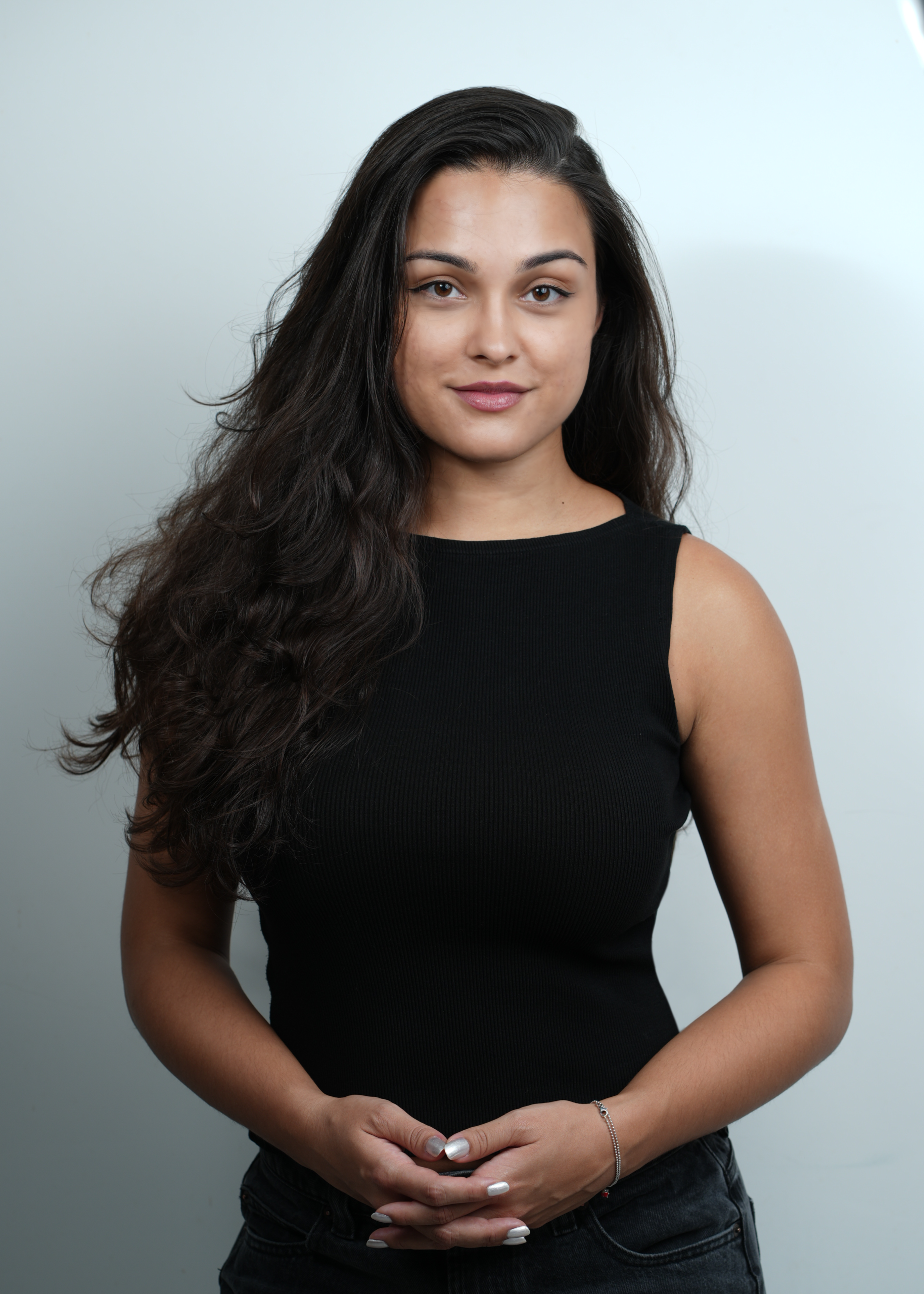
Tell us about yourself and your background. How did you discover your passion and turn it into a female-business-leader-spotlight-rawan-arnaout/”>business?
Growing up with two architect parents meant learning to see details in function and aesthetics. Every holiday came with a lesson in why a place was relevant historically, regionally and globally. Those stories connected across countries, cultures and centuries. I continued to explore these connections from a science, history and art perspective.
Later I focused on how they create networks that are active at scale, from big brands all the way down to individual people. How can someone have a deep connection with something intangible, a message or an ideal, and how is that made tangible through digital and physical channels? That question motivated me to explore how brand systems are built, maintained and evolved through communication and design.
I have always been creative but have a very analytical approach
I would not describe myself as an artist as I do not create for interpretation but for guidance and problem solving. Design focuses on the balance between information and aesthetics.
What makes design fascinating is how it works as a system. An always-on pipeline keeping audiences engaged through planned, connected touchpoints; a website, a post, a newsletter, a storefront, or a product. Each one is a design decision, and it takes at least 7 of those interactions before a person remembers a brand. Most people are visual learners, responding to how something looks before deciding if the text is worth reading. Visuals and messages must work together. One can’t exist without the other.
My approach has always been interdisciplinary. Communications design gave me fundamentals and design thinking. Interaction design showed me user expectations and how to build personas from research. UX helped me map audience journeys and test responses. UI taught me how to layer function with aesthetics to guide people toward a goal. All of it feeds into brand level work creating visuals, messaging and touchpoints for a strong presence on and offline.
Tell us about your freelance practice and who you work with.
Design is most interesting when disciplines, industries and audiences are new or evolving. I built a freelance practice to work in different areas. I’ve worked with companies in technology, human rights, brands in fashion and education, all the way to festival identities, and systems that are built to last. This often means developing a core identity with flexible elements that adapt to new trends, audiences, and markets.
Either a new element needs to be added to an existing brand identity, an element is inconsistent and disrupting the brand experience, or a new identity needs to be built from scratch. These all come back to the same question of how a brand element fits into the broader brand ecosystem.
I work with founders and entrepreneurs to answer that question. They know what they want to do but need to find a way to make it visual, memorable, and consistent for their audience. Something the audience can connect to, that helps them put it into context.
That’s what I build. Starting with research to understand the audience, exploring touchpoints, mapping competitor activity and best practices to later develop or evolve a brand identity that is used consistently. The system comes first, then the individual touchpoints.
The balance between information and aesthetics is what helps my clients understand that design is a functional discipline that aligns with their business objectives.
Why should entrepreneurs and founders approach design as a discipline, not just an aesthetic tool?
McKinsey’s Business Value of Design report found that design-led companies outperformed their industry peers by 32 percentage points in revenue growth over five years. That is a clear business metric. It starts with treating design as a discipline, not as a finishing touch. Aesthetics is only the tip of the iceberg. It is the part people see, including the brand colours, logo, and content. But underneath is the structure that makes all that easy to understand.
Design thinking is a methodology. The same rigour businesses apply to product development or operations is applied to how a brand communicates. Research, problem definition, testing and iteration. It is a creative and logical process, with the audience at the centre of every decision. Design is the first impression a brand makes, so only adding it later is risky. Every pitch deck, every proposal, every social post involves a decision about how to present information. Design is how to make that decision.
Most founders underinvest in design and see inconsistencies later that are costly to fix. What usually needs fixing is not the aesthetic layer but the lack of a system to support it. If there was no creative strategy guiding the visual decisions, no consistency across touchpoints, no defined audience shaping the message the problems will build up.
A logo is great, but it’s often mistaken for enough to be a full brand identity.
What is your methodology? How is your approach unique?
I think of brands the way architects think of buildings. Every element has a structural purpose, and nothing works in isolation. Living in Kuala Lumpur, Munich, Milan and New York gave me a cross-cultural lens that influences how I consider audiences. How brands need to adapt to different contexts and meanings or what trust preferences are like for different people. Those things need to be considered when it comes to designing a brand.
What I focus on is the brand ecosystem, the interconnected system of all brand elements: strategy, identity, content, messaging, and experience. The big picture can’t be forgotten even when working on individual parts. I build and oversee the whole system, which means I am always looking at how positioning influences message, how message informs visual hierarchy, and how that affects how someone will feel when they see the brand.
A big part of my process is research and testing
I explore what is possible to push further than a brand might go on its own, so we can see where the boundaries are. A design might not even have to change, but knowing what can change is what makes a brand future-proof. Everything stays aligned with business objectives, and clients are involved throughout, by making the process collaborative. Design decisions are easier to accept when the reasoning behind them is clear. A brand built this way does not need to be rebuilt every time something changes, because it already knows how to adapt.
How do you balance aesthetics and information in your work?
Aesthetics and usability are the delivery mechanism for information. Information always needs to be reduced and refined so audiences get the most important bits to move them closer to a defined goal, whether that is following a brand online, downloading an app, or walking into a store to make a purchase.
Information will always come first. A simple way to test this is if it works in black and white, it will work in colour. Colour should never be the thing holding a design together. If the hierarchy is clear, the message is direct, and the audience knows where to look without any help, then the design is working.
What that means in practice is that no aesthetic decision is made before the information is solved. What does the audience need to understand? In what order? What is the goal of this specific touchpoint? Once those questions are answered, the aesthetics follow naturally and they serve the information rather than work against it.
That balance is what makes a brand consistent. When every element is built with the informational logic, the aesthetic can stretch across platforms, formats, and markets without losing coherence. It looks different but it always feels like the same brand.
Why is it so important for global brands to start by defining their audience?
Most brand failures are audience related. You can have the strongest visual identity in the world that doesn’t attract anyone because it’s not speaking to anyone. Messaging and design decisions will be strongly influenced by your audience segments.
For global brands this matters more, because of all the audience groups they’re speaking to. Individuals who have grown up in different cultures, languages, and environments. A cookie-cutter experience will not help grow the brand. A useful starting point is 2-4 audience personas. Find someone who understands the region, because some cultural nuances cannot be reverse engineered from the outside. Once you know your audience, everything else follows; where they are active, how your message adapts per platform, and how to apply local language options.
The real challenge for global brands is building local communities that still feel connected under one brand umbrella. Local enough to feel relevant and consistent enough to feel recognisable on a global scale. That is where getting the audience definition right at the beginning makes all the difference.
How do you ensure consistency across the brand ecosystem?
Consistency is one of the most misunderstood concepts in brand design. Most founders think it means everything looks and sounds the same across every platform. What it means is that the core of your brand, including positioning, tone, identity, is non-negotiable, and everything else has enough flexibility to adapt to your audience and changing environments.
This is where the concept of a brand ecosystem helps the logical layer of communication and design. There are clear elements at the core and deliberate flexible ones that are used across different platforms and formats. Audiences have built-in intuitions from years of interacting with design. You want to work with those intuitions and then add a layer of uniqueness that keeps the brand relevant. Frequency matters just as much, all the design in the world will not help if your audience does not see your brand often enough to remember it. Presence and consistency must work together. That is what builds a recognisable brand.
You also contribute to Sumea Social — tell us more about your work here.
I bring what I know about corporate brand design into personal branding. The concept of a brand applies directly to a person, but the biggest difference is that the audience has someone to connect to directly. There are fewer intangible qualities to work around and significantly more room to experiment. A person can speak about their experiences, insights, and personal life in ways a corporate brand simply can’t. That directness is what makes personal branding reach many people quickly when it is done well.
Working with Svenja Maltzahn is very valuable in this role. Her hands-on approach to client relationships, PR and digital media is showing me a new side to interdisciplinary working and that the best creative work happens when the client feels understood and included in the process. Her approach to business is something I hope to replicate one day.
I love learning about different disciplines through the people I work with
Their expertise and the parts of their life outside of work – such as sports and hobbies – all of it becomes content material. The range of what one person can speak to across different topics is what makes a personal brand ecosystem interesting to build. Every person is a different system to figure out.
My role as Creative Strategist is to build those systems, fill them with content, and make sure each person’s voice comes through clearly and consistently. When personal and corporate brand strategy work together, the impact on visibility and positioning is greater than either one alone.
What is next for you?
The combination of personal and corporate brand strategy is a space I am actively working in as the line between a founder’s personal brand and their company brand is blurring. That intersection is where some of the most interesting work is happening. As more brands expand across the GCC and Southeast Asia, cross-cultural design literacy becomes critical. My focus is making strategic brand thinking more accessible to founders and understanding design as a functional, foundational layer to their brands rather than an afterthought.
Where can readers connect with you?
LinkedIn is the best place to connect with me. I post regularly about the design discipline focusing on brand identity, design ecosystems, audience segments and cross-cultural design strategy. If this raised a question, bring it to my comments or DMs.