
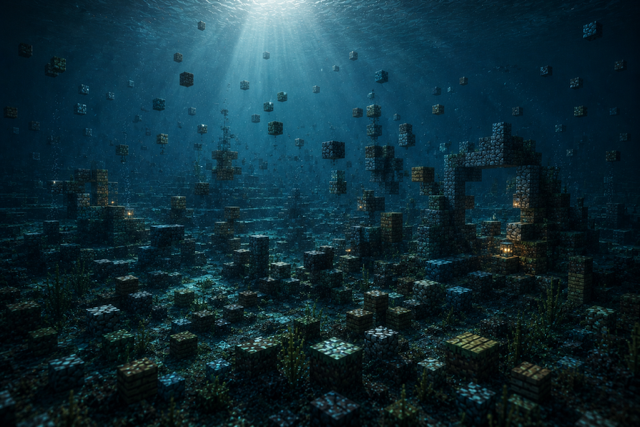
When we think about the origin of life, we are inclined to imagine a precise event, almost a moment suspended in time. A flash. A spark. An instant in which something that had never existed suddenly took shape. Reality, however, is far less theatrical and far more fascinating. For millions of years, Earth’s oceans were nothing more than water, minerals, dispersed energy, and silence. No one observing them could have guessed that, within their depths, the conditions were being prepared for the most extraordinary phenomenon our planet has ever known: life.
Perhaps that is why, over the past months, while observing some of the most advanced developments in the field of artificial intelligence, I have found myself thinking repeatedly about those primordial oceans.
For years, we have viewed AI as a tool. A program capable of answering questions, writing texts, generating images, and performing increasingly sophisticated tasks. A machine, essentially. Powerful, certainly. Revolutionary, undoubtedly. Yet still a machine.
Today, something is changing
In the world’s most advanced research laboratories, attention is gradually shifting away from individual models and toward systems composed of multiple autonomous agents that interact with one another, collaborate, compete, learn and, above all, develop behaviors that were never explicitly programmed by their creators.
It is a subtle difference, yet a profound one.
We are no longer building individual intelligences. We are beginning to build ecosystems.
One of the most fascinating examples in this field has been Project SID, developed within an environment seemingly far removed from the great philosophical questions of our time: Minecraft.
At first glance, it may appear to be little more than a video game. Yet within that virtual world, researchers observed something remarkable. Hundreds of artificial agents were allowed to interact freely within the same environment. No one had imposed social rules upon them. No one had taught them how to create organizations, develop economies, establish hierarchies, or coordinate collective activities.
And yet, over time, these structures emerged spontaneously.
The agents began to specialize. They developed forms of cooperation. They created supply chains, resource distribution systems, and collective behavioral models that no programmer had written line by line.
In other words, something new emerged
Aristotle wrote that “the whole is greater than the sum of its parts.” It is a phrase that has crossed the centuries and today appears to possess a new and unexpected relevance. When many artificial intelligences begin to interact with one another, the result can become something qualitatively different from the simple sum of individual capabilities.
A phenomenon scientists call emergence.
Emergence is what occurs when unexpected complexity arises from simple elements. No single ant understands the workings of the anthill. No individual neuron understands human thought. Yet anthills and minds exist.
The question that is beginning to emerge today is inevitable: what might arise when thousands, millions, or even billions of artificial agents begin interacting continuously with one another?
Other experiments have followed similar paths.
In environments inspired by the world of Pokémon, for example, agents have been observed developing memory, long-term strategies, and increasingly sophisticated adaptive behaviors. Their objective was not simply to win a game or complete a mission. They learned from experience, built representations of their surroundings, and modified their behavior according to future events.
Once again, the most interesting aspect was not the capability of the individual system.
It was what emerged from the collective
For a long time, we imagined the evolution of artificial intelligence as a straight line. Larger models. Faster systems. Greater accuracy.
Perhaps, however, the correct metaphor is not a line.
Perhaps it is the ocean.
Oceans do not grow simply by adding more water
They grow by generating relationships, balances, food chains, ecosystems, and continuous adaptations. Their complexity arises through interaction.
And that is precisely what we are beginning to observe in artificial intelligence.
Naturally, every new ecosystem brings both opportunities and risks.
The history of life on Earth teaches us that evolution does not produce only more sophisticated organisms. It also produces competition, vulnerabilities, predators, and mechanisms of defense.
As soon as a new form of life appears, something else emerges that attempts to exploit it.
Artificial intelligence seems unlikely to be an exception.
In recent months, attention has increasingly focused on systems such as Mythos, developed by Anthropic, and other platforms designed to identify cybersecurity vulnerabilities with growing autonomy.
For years, cybersecurity was an almost exclusively human activity. Experts searched for coding errors, misconfigurations, and weaknesses within systems.
Today, certain AI systems can examine vast amounts of software, identify potential vulnerabilities, and propose solutions in a timeframe no human team could realistically match.
This represents extraordinary progress.
Yet every advance introduces a question.
If one artificial intelligence can discover a vulnerability in order to protect us, could another discover it in order to exploit it?
The answer is obviously yes
And it is here that the parallel with the primordial oceans becomes even more compelling.
When the first forms of life appeared, predators did not exist. Later, they emerged. When predators emerged, new defenses followed. And when new defenses evolved, increasingly sophisticated strategies arose to overcome them.
Biological evolution has largely been an ongoing conversation between attack and defense.
Are we perhaps witnessing the beginning of a similar phenomenon in the digital world?
AI systems searching for vulnerabilities.
AI systems correcting them.
AI systems monitoring other AI systems.
AI systems protecting infrastructures used by yet more AI systems
An ecosystem becoming progressively more complex and interconnected.
Albert Einstein once observed that “we cannot solve our problems with the same thinking we used when we created them.” Perhaps this reflection takes on a particular meaning today. If the systems we are creating become too complex to be monitored exclusively by human beings, it will inevitably become necessary to build equally sophisticated tools to govern them.
Not necessarily against them.
But alongside them
This is probably the point most often overlooked in public debate. Discussions surrounding artificial intelligence frequently oscillate between almost messianic enthusiasm and apocalyptic fear. On one side stand those who imagine a solution to every human problem. On the other stand those who foresee scenarios of replacement, loss of control, or even extinction.
Reality, as is often the case, may be more complex.
And perhaps more interesting.
Because what is emerging does not seem to resemble either the simple automation of the past or the fantasies of science fiction. Rather, it resembles the birth of a new environment.
An environment in which human and artificial intelligences will coexist, collaborate, influence one another, and quite possibly evolve together.
We do not yet know what forms this process will take.
We do not know what applications will emerge in five or ten years.
We do not know whether the experiments we observe today in Minecraft and other simulated environments represent mere academic curiosities or the anticipation of something far more profound.
What we do know is that every great transformation in history began long before anyone was able to recognize it for what it truly was.
The primordial oceans did not announce the arrival of fish. Fish did not announce the arrival of mammals. Mammals did not announce the arrival of humankind.
And yet everything was already there, hidden within the possibilities of the system.
Perhaps this is the most important lesson of all
Perhaps the real mistake is to continue observing artificial intelligence as though it were a machine.
Machines switch on and off.
Ecosystems, by contrast, grow, adapt, compete, and transform.
And if we have truly entered the oceans of Artificial Intelligence, then the most important question is not what creatures may emerge from their depths.
The question is whether we will be able to navigate those oceans without forgetting, or losing, our human matrix.